
Known as Artemisia vulgaris, Mugwort has also been referred to as “crone’s wort” or “witch’s wort” throughout the span of time. Naturally it is a weed, popping up in desolate regions throughout Europe, North America and Asia. In common folklore, Mugwort is said to grow at the doorsteps of healers, giving the plant reputation as Crone’s Wort. Thus, it has a long association with witches and wild women.

Greek Goddess, Artemis and Queen of the Witches
As the plant’s Latin name implies, Artemisia vulgaris, it is associated with the Greek deity Artemis. In Roman mythology, she is known as Diana. She is the wild huntress, Queen of the Witches, associated with the moon and women’s mysteries.
Not only was Artemis a Goddess of the Hunt, but she spent the majority of her time in the forests of Ancient Greece. She spent her days and nights traveling with 13 hounds, which she had received from Pan, 20 Nymphs, and other hunters and mortals. One of the most famous hunters that Artemis is associated with is Orion. After Orion’s death, she erected him into the night sky, where he became one of the most viewed constellations during the Winter.
Artemis knew all of the plants and herbs of the forest and their remedies. She is most commonly associated with Cypress, Palm and Walnut trees. There is no folklore linking Artemis directly with Mugwort. However, much of the plant’s attributes are parallel to the mysteries of Artemis.

When it comes to Feminine hygiene, Mugwort has many uses. When taken internally, it can stimulate the menstrual cycle and is known to decrease heavy cramping during menstruation. During the medieval time period, it was said to induce miscarriages, especially if the woman was unhealthy and her pregnancy could result in death.
The Plant’s Connection to Dreams and Visions
The most widely-known use for Mugwort is lucid dreaming and visions. The herb is known to stimulate the brain and helps with memory. This is the main reason that it causes dreams and visions, as it irritates the visionary receptors in the brain while sleeping.
Mugwort’s cousin, Wormwood, or Artemesia absinthium is known to have similar effects to the brain, but on a more enhanced level. Absinthe is an alcoholic drink made from the Wormwood plant, which may cause psychedelic visions.
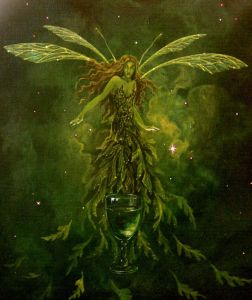
Absinthe is lovingly referred to as “The Green Fairy.” Like the Fey, it is known to enchant and is said to induce wild visions. People will commonly feel as they have entered another place, somewhere far away, yet so close. Some even claim to see spirits or hear voices. Mugwort is the safest plant within the Artemesia Genus, as other Artemesias are known to cause epilepsy, heart disease and kidney failure due to the high concentration of thujone.
Mugwort’s Role after the Rise of Christianity
Mugwort in ancient times was used to make beer up until the 15th century, where hops became beer’s primary ingredient. Why was that? It is believed that because of Mugwort’s association with Artemis, witches and as an aid to connect with the supernatural world, it was rejected by Christianity. Coincidentally, the word mug was derived from the Mugwort plant, as a drinking vessel to hold the ancient beverage.
During the Middle Ages, the plant became heavily associated with Saint John the Baptist. It was believed that the Saint wore the plant as a girdle while he was living in the wilderness. Even in Ancient Ireland, mugwort was burned at sacred sites, like Newgrange. Young girls would wear the plant around their head and hips and throw it on a fire on the night of Midsummer’s Eve, which was said to enhance protection. After the rise of Christianity, the act of burning the plant had become associated with Saint John the Baptist and Midsummer’s Day, June 24th, was adapted to the Saint’s celebratory day.
 Spiritual Folktails
Leave a comment