What is a Yokai?
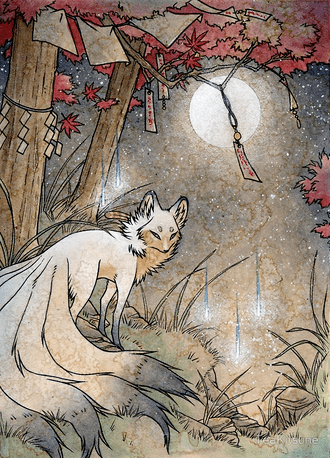
The word yokai directly translates to “strange apparition.” The term refers to supernatural entities or spirits within Japanese folklore. Yokai can be referred to as ayakashi, yokai that appear above the surface of water; mononoke, vengeful or malevolent yokai; or mamono, meaning goblin. Yokai are not demons but are more like entities or spirits and can be sometimes considered as enlightened. Their behavior ranges from malevolent to neutral to benevolent.
So, what sort of Yokai exist? Japanese folklorists and historians explain yokai as personifications of “supernatural or unaccountable phenomena to their informants.” There are records of hundreds, if not thousands of yokai. In Japan, it is believed that even mundane objects have a spirit. It is for this reason that newer yokai, referred to as amikiri, will reappear out of inspiration from earlier folklore or from one’s own imagination.
What exactly is a Kitsune?
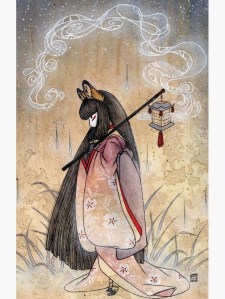
Kitsune are fox spirits that are associated with Inari, a Shinto deity. Inari herself is not a fox, but she has a special connection to foxes. Kitsune are seen as messengers between humans and the supernatural world and can bring messages directly to and from Inari. The kitsune have the ability to shapeshift and are especially known to shift into a beautiful feminine figure.
The belief of the kitsune is commonly known throughout Japan, especially due to the increasing popularity of manga and anime. Many series incorporate the kitsune yokai into their plot, especially in popular media such as Naruto, Inyuasha and Pokemon. But these fox spirits have a long history.
History
In the researching the history of Kitsune, normally it is mentioned that the legends of the kitsune are borrowed from China and before that, had originated in India. However, I couldn’t find specific dates for these claims. I did however find stronger links that Kitsune has to Japan. The first connection to foxes in Japan dates back to the Jomon period, about 14500 BCE to 300 BCE, which is Japan’s earliest historical era. Upon discovering a necklace made from the teeth and jawbone of a fox, the relationship between Japan and foxes had been established.
Nihon Shoki, which translates as “Chronicles of Japan,” is the second oldest book on Japanese history, had been compiled in year 721. It was within the pages of Nihon Shoki that foxes first appeared as supernatural beings that taught people about good and bad omens. Later in 822, another book had been complied named Nihon Riyoniki, Japan’s earliest Buddhist setsuwa, a literary form consisting of folklore, mythology, and fairy tales. The volume contained the first tale about a person having a relationship with a female kitsune.
The connection to China can be found within Chinese folklore about fox spirits called huli jing that have been reported to have up to nine tails. These fox spirits were adopted to Japanese culture through merchants and referred to as kyubi no kitsune in Japanese. Many of the surviving stories were recorded in the Konjaku Monogatarishu, a Japanese collection of writings from the Heian Period, approximately from 794 to 1185. The unique collection contained Japanese, Chinese and Indian tales and consisted of 31 volumes.
The Tails of a Kitsune
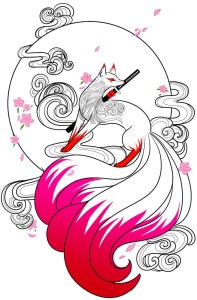
Kitsune can have as many as nine tails. Generally, the amount of tails a kitsune has determines its age and power. In some folklore, the kitsune is believed to grow another tail every 100 years. A kitsune having one, five, seven and nine tails are most common numbers in folktales.
In the wild, foxes are known to live roughly one to three years and in captivity, their lifespan can last up to ten years. This shows that kitsune are not like the foxes that live in the wild but are supernatural entities instead.
Kitsune that have nine tails, in Japanese, are called kyubi no kitsune, may gain supernatural abilities. Kitsune are known to generate lightning and fire, however, the abilities that a kitsune may have are endless. In some tales, they are accredited to omniscience, or infinite wisdom.
After reaching 1000 years in age and acquiring its ninth and final tail, the kitsune is said to turn a white or golden color and becomes a tenko, a heavenly, celestial fox. This is the most powerful form of a kitsune and has the ability to ascend into heaven.
Who is Inari?
Inari is a kami, the Japanese word meaning divinity or deity within the Shinto religion. She rules over agriculture, rice, tea, fertility and abundance. Inari is also heavily connected to foxes, who are seen as the divinity’s messengers.
Inari can be depicted as a female entity as well as male. In her feminine aspect, she is an abundance goddess with long flowing hair and in the male aspect, he is an old man carrying grains of rice. Inari had always been represented as a female divinity until the rise of Buddhism in Japan, when a lot of popular female divinities were changed to male.
According to myth, Inari appeared during a harsh famine that struck the land during ancient times. She was described as descending from Heaven riding on a white fox, carrying sheaves of grain.
Foxes were seen as sacred in Japan due to them being a natural enemy of rats that eat up the rice or burrow into rice paddies. Since fox urine has a rat-repelling effect, a stone with fox urine was commonly placed on a hokora, a miniature Shinto Shrine that is in proximity to larger Shrine dedicated to a kami, near a rice field. This was a way for farmers to protect their crops as well as have a small area dedicated to Inari and her kitsune on their land.
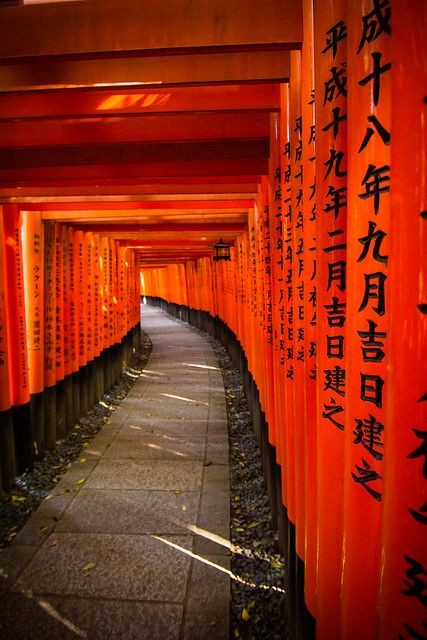
More than one-third of Shinto shrines in Japan are dedicated to Inari. In 1985, a survey conducted by the National Association of Shinto Shrines counted 32,000 shrines dedicated to this divinity. This number does not include small roadside or field shrines, shrines kept in a home or office, smaller shrines without full-time resident priests and shrines on the property of Buddhist temples.
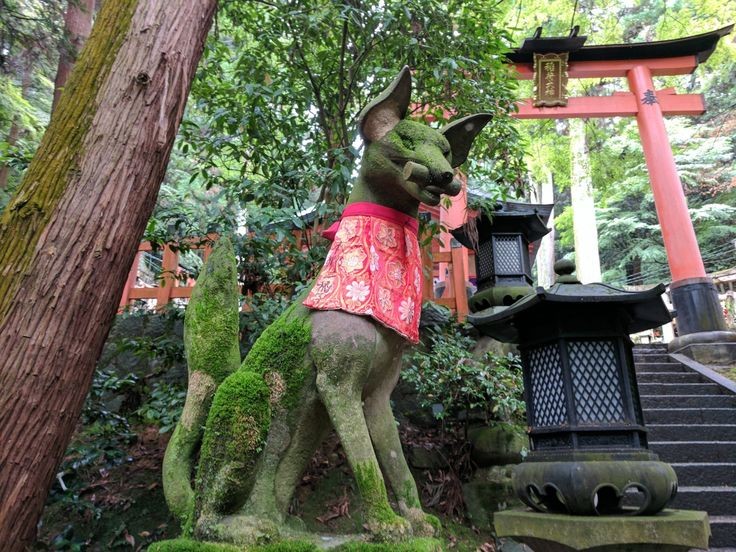
The entrance to an Inari shrine is marked by vermillion torii, a traditional Japanese gate located at the entrance of a Shinto shrine, as well as statues of kitsune. At these shrines, it is common for the kitsune statues to be adorned with yodarekake, votive bibs in the same vermillion color, as a sign of respect. This shade of red has come to be identified with the presence of Inari.
Mythology
One of the more popular tales is entitled Kuzunoha, in which many in Japan attribute as a realistic event. It begins when a nobleman by the name of Yasuna was visiting a shine in Shinoda, located within the Settsu Province. He encounters a man who was hunting foxes in order to make medicine from the creature’s liver. Yasuna duels with the hunter and eventually frees a white fox.
On Yasuna’s way home, he meets a beautiful maiden who walks him home to attend to his wounds. He accepts the maiden’s presence without knowing that she was the very same being that he had saved from the hunter. Her name was Kuzunoha, and she was the guardian of the shrine. The couple end up marrying and have a child together named Seimei.
Several years later, while viewing the chrysanthemums, Kuzunoha’s son catches sight of her tail beneath her robes. Since her true nature had been revealed, Kuzunoha knew that she must return to the wild. She leaves Yasuna a farewell poem, asking him to see her in the Shinoda Forest.
Yasuna and Seimei leave in search of Kuzunoha. Eventually she emerges in her true form, a fox. Thus, revealing that she is the kami of the Shinoda Shrine. She gives Seimei a supernatural gift that would allow him to understand the language of animals.
If you love me, darling, come and see me.
You will find me yonder in the great wood
Of Shinoda of Izumi Province where the leaves
Of arrowroots always rustle in pensive mood
Translated by Kiyoshi Nozaki
 Spiritual Folktails
Leave a comment