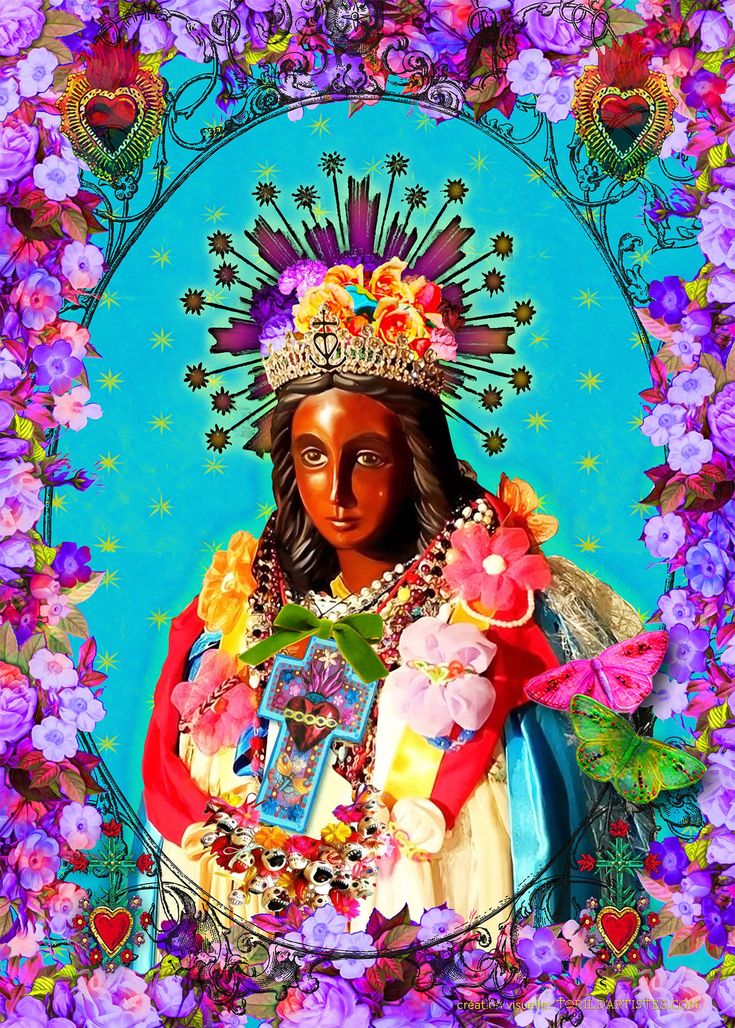
Sara La Kali is the Patron Saint of the Romani people and lovingly referred to as Queen of the Roma. But who exactly are the Romani people? They are defined as an Indo-Aryan ethnic group Although the Roma do not have a home country to call their own, they come from the Indian subcontinent, specifically in the Rajasthan region.
The Romani are often described as nomadic, being that they had migrated on foot, around 500-1000 CE, from India to Europe and Western Asia and settling into communities in the 14th century. Upon arriving into Europe, the Romani have been ostracized and outcasted from society, suffering from slavery, hunger and war.
For hundreds of years, the Romani have been categorized under the word gypsy, but being that that word has negative connotations, it has become an offensive term. People within this ethnic group prefer to be referred to as Roma or Romani.
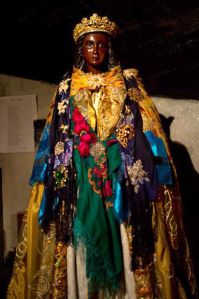
Who is Sara La Kali?
Being the patron Saint of the Romani people, she has a deeper meaning for the Roma. She became Saint Sara with the rise of Christianity in Europe, but she is truly the Hindu deity, Kali.
Those that came from India to Europe at the time practiced something called Shaktism, where the supreme Godhead was seen as a feminine form. Shakti is defined as the active Divine energy that powers all forms of creation. Therefore, this principle lies within the feminine mysteries. It is associated with the power of the Kundalini, an energy that sits in the base of the spine and travels up to the chakras, awakening spiritual powers within. This power center occurs naturally in women. Men have to maintain constant meditation for years before they can awaken this power.
At the height of Shaktism, the practice acknowledged and paid homage to all female principals within the Hindu pantheon, but the most popular feminine deities were Durga, Paravati and Kali.
Durga and Kali
Now to understand the power of Kali, let’s first discuss Durga. The reason being is that Kali is a fierce and hot version of Durga. They both will offer protection and love, but Kali brings with her a burning fire and destruction.
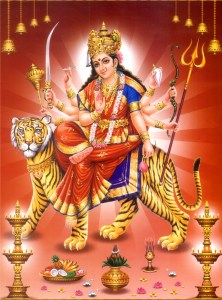
Durga sits atop a tiger, holding a weapon in each of her six hands. She smiles the way a mother would at her child, with compassion and sweetness. Only those who are not pious will see her vengeance! To those that she protects, she displays a kind and sweet demeanor. She is the shakti of protection from harm and evil forces. Her seed sound is DUM, pronounced doom, which can be recited in place of a full mantra.
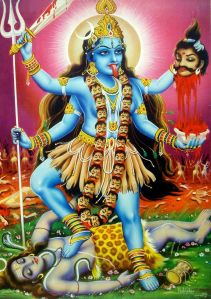
Kali is described as a ‘terrible’ aspect of Durga. It is not that she is terrible, but she is the wild, raw energy of Durga. She is the destroyer! While Durga gently protects her children, Kali rips away negativity. Reciting her mantra can be overwhelming for some people, causing headaches and dizziness. In such cases, it is recommended to work with Durga first. Kali is a warrior. Just look at her! She dances on the body of Shiva with her tongue protruding callously. She wears a necklace of decapitated heads and a skirt made from human arms. She holds in one of her hands, a bloody machete. She isn’t only ready for war; she is undefeated in every battle. Her seed sound is KRIM, pronounced kreem, which can be recited in place of a full mantra.
Veneration of Sara La Kali
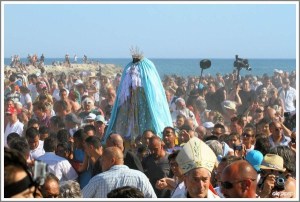
Every year on May 24th, a ceremony is held to Saint Sara in Saintes Maries de la Mer, which is located in Southern France. Her statue is carried down to the sea to re-enact her arrival in France. This ritual is similar to venerations in India, where statues are carried to bodies of water that are said to be sacred within ancient Hindu texts and washed within holy waters of the Ganges.
 Spiritual Folktails
Leave a comment