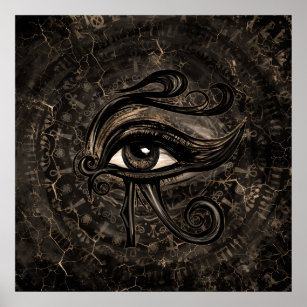
What is the Eye of Horus
The Eye of Horus is a symbol of a left eye, believed to have protective magical power. According to a myth involving Horus and Set, the eye had been destroyed and then reassembled. In most Myths, Hathor was involved and in some, it was Thoth. Hathor used her power to reassemble the eye and then Horus gave the eye to his father, Osiris to sustain his life in the afterlife. The passing of the eye from one deity to another is what gave the Eye of Horus its increasing power.
The Eye of Horus was only a singular eye, and it came to symbolize healing and the concept of making something whole again. The Egyptian name for the eye is wedjat or udjat, meaning “whole, sound.”
Wedjat eyes became powerful amulets and in the form of jewelry they often adorned the neck and wrists of both the living and the dead. Being one of the most common symbols for amulets, its popularity started in the Old Kingdom (c. 2686-2181 BC) and continued throughout the Roman Period (30 BC – 641 AD).
The Eye of Horus commonly appeared on the sides of Middle Kingdom (c. 2055-1650 BC) coffins to protect the deceased and allow the dead to see the happenings outside of the coffin. The symbol had been adopted by other cultures surrounding Egypt and can be seen in areas such as Syria, Canaan and Nubia.
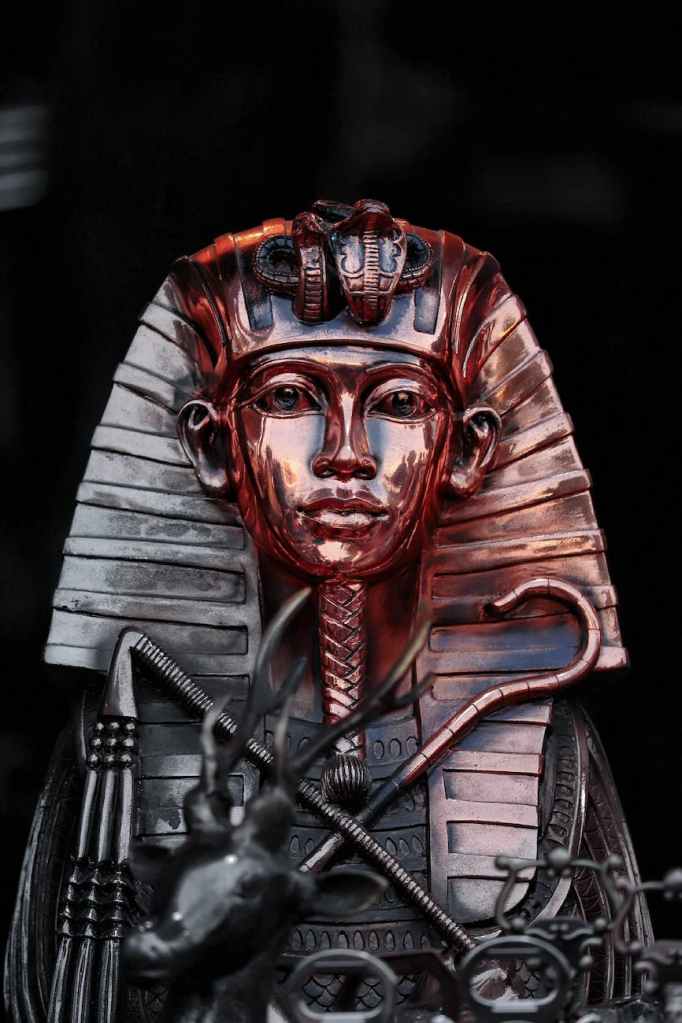
Conflict Between Horus and Set
The Eye of Horus was created out of conflict between Horus and Set. The throne of Egypt belonged to Set, deity of chaos and storms, since he had abolished his brother and Egypt’s predecessor, Osiris. Osiris’ limbs had been scattered across the desert. With the help of Isis, Osiris’ wife and Nephthys, wife of Set, the two women were able to locate all the pieces of Osiris and put him back together. At this point, Isis was able to procreate with Osiris and give birth to their son, Horus.
As soon as Horus was old enough to challenge his uncle, Set for the throne of Egypt, he went before the Ennead, which were the nine deities of Egypt that had been worshipped at Heliopolis; Ra-Atum, his children Shu and Tefnut; their children Geb and Nut; and their children Osiris, Isis, Set and Nephthys. The majority of the Great Ennead sided with Horus, besides Set and Ra-Atum. Isis had attempted to trick Set by disguising herself as an old woman. She crafted a similar story in which a man had killed her husband and took her son’s cattle. She pleaded with Set to state that what the man did this was wrong and that Set would help them regain their dowry. Set agreed and by doing so, he condemned himself.
However, Set could not admit defeat and stated that the rightful ruler of Egypt must beat him in strength. Set and Horus agreed to turn themselves into hippopotami and fight under the river. The first man to surface would be the loser. Isis tried to help her son win the fight by throwing a spear at Set. Out of anger, Horus jumped up out of the river and decapitated his mother for trying to interfere. Afterwards, Set found Horus sleeping under a palm tree and gouged out his eyes. The following day, lotuses emerged from the spot where Set had buried Horus’ eyes. When Hathor, maternal cow goddess, found Horus, she poured milk into his wounds, healing his eyes. Once Horus was able to see once again, he went back to the Ennead to confront Set.
Again, Set requested another test, but this involved embarking on a race on the Nile. Set had managed to sink Horus’ ship and Ra-Amun became angry at the fight that ensued. Eventually, Thoth, scribe to the Gods, came to his aid. He wrote a letter to Osiris in the land of the Dead to mediate the dispute between his brother and his son.

Connection to Planets and Stars
Was it just one eye or were there two after all? Horus was a sky deity. Many Egyptian texts explain that Horus’ right eye was the sun and that his left eye was the moon. The two eyes are often equated with the red and white crown of Egypt.
The concept of Horus’ eyes representing the sun and moon has created a debate of whether the Eye of Horus is connected to the Eye of Ra. The argument is that the Eye of Ra is Horus’ right eye. However, Ra is a solar deity in his own right and is often personified as a Goddess.
Originally, it was Egyptologist Richard H. Wilkinson who made the claim that the Eye of Ra was Horus’ right eye. However, other Egyptologists argue that this theory doesn’t have any written evidence until the New Kingdom (c.1550-1070 BC). Rolf Krauss explains that the Eye of Horus originally represented Venus as the Morning and Evening Star. It wasn’t until much later that it had become associated with the moon.

Eye of Horus in Magic and Ritual
The Eye of Horus came to symbolize funerary offerings, especially since it had been given to Osiris in the Afterlife by Horus. It came to represent offerings and sustenance given to the Gods within the temple. There are even versions of the myth where flowers or grapevines grow from the buried eyes, which reinforces the connection between the Eye of Horus to ritual offerings. Offerings such as perfume, food and drink were created by the plants that emerged from the eye.
Interestingly, the Eye of Horus was also equated with Maat, which was the Egyptian concept of truth and cosmic order. In Egyptian, the word maat represents truth, justice, and cosmic order. But there is also goddess that goes by Maat that oversees these concepts as well. The idea that the Eye of Horus is associated with maat, or cosmic order,is based upon maintaining ritual offerings for the survival of the ritual temple.
Ancient Egyptian medicine involved practical treatments as well as rituals that invoked the divinities. Ironically, the Egyptian medical papyri didn’t distinguish the two forms of healing, suggesting that medical procedures and spirituality were performed together. Healing rituals commonly compared patients with Horus, as he had been healed within Egyptian mythology. Because of this, the Eye of Horus is commonly used in healing rituals. Interestingly, the Eye of Horus was invoked as protection against eye disease. In the Papyrus Leiden I 348, the medical text associates each body part with a particular deity who oversees that body part or organ. As such, the left eye is associated with the Eye of Horus.

Now You See Me: Is the All-Seeing Eye Connected to Performance Magicians?
The movie, Now You See Me, released in 2013, was the inspiration that led me to research and write about The Eye of Horus. Throughout the movie, it is mentioned that an ancient organization of magicians, including illusionists, hypnotists, and the like, was referred to as The Eye, which is synonymous with the Eye of Horus, dating back to Ancient Egypt. As the legend goes, slight of hand was used to steal from the rich and give to the poor, balancing out the scales of justice.
It’s an interesting concept: Spirituality being associated with Slight of Hand. As I watched the movie and even thereafter, I pondered the idea that there was a potential that occult magic and performance magic were one in the same, or at least, connected.
Upon researching the history of magic, the father of modern entertainment magic was Jean-Eugene Robert-Houdin during the 19th century. However, there is evidence that suggests that slight of hand and illusionary tricks were used long before the 19th century.
The term “magic” was derived from the Greek word mageia. During ancient times, Greeks and Persians had been at war for centuries. The Persian priests were known as magosh in Persian and came to be known as Magoi in Greek. Ritual acts of the Persian priests came to be known as mageia and eventually magika, which referred to any foreign, unorthodox or illegitimate ritual practice.
This means that any person who was able to perform successful acts of illusion would be called magoi. The performance of tricks, magical illusion and apparent works of such acts were referred to as magic. In 1584, a book by the name of The Discoverie of Witchcraft, was one of the earliest known records to explain secrets of magic. Its author, Reginald Scot wrote the volume to stop people from being executed in the name of Witchcraft. After which, many books were published that described magic tricks in the 17th century.
These sources prove that illusionary magic has been around before the 19th century. However, when thinking about the logic of the supernatural world, there are parallels. Magic doesn’t exist the way most of the world sees it. For example, you cannot wish for a million dollars and wake up to check under your pillow. There are rules and logic. For magic to work, the thing that you are requesting must come from another source. I am reminded of a story I learned from a friend, where the friend was paid to do a Road Opener work for a client. This client had about $30,000 in student loan debt. One day after the work had already been performed, the client had logged into the loan account and realized that the account had a zero balance. She reached out to the loan company to inquire why her loan had suddenly disappeared. She thought it was an error and did not want to accrue late fees. The bank representative told her that someone had elected to pay off her loan privately.
There truly is nothing that will manifest out of thin air, it must be taken or within emotional circumstances, gradually accumulated. Magic is in essence, the manipulation of energies to one’s benefit. Illusionary tricks work in this same way. Since both types of magic are connected, then it is easy to assume that performance magic had been around since at least Ancient Egypt.
However, being that the Eye of Horus has connection to the goddess Maat and ultimately, cosmic order, it wouldn’t necessarily relate to the act of stealing, whether or not the rich had gained their wealth with ill intent. Magic was used by the less fortunate to create better lives for those who were suffering and ultimately, the theory could be debated whether taking from the rich and giving to the poor is justified.
 Spiritual Folktails
Leave a comment