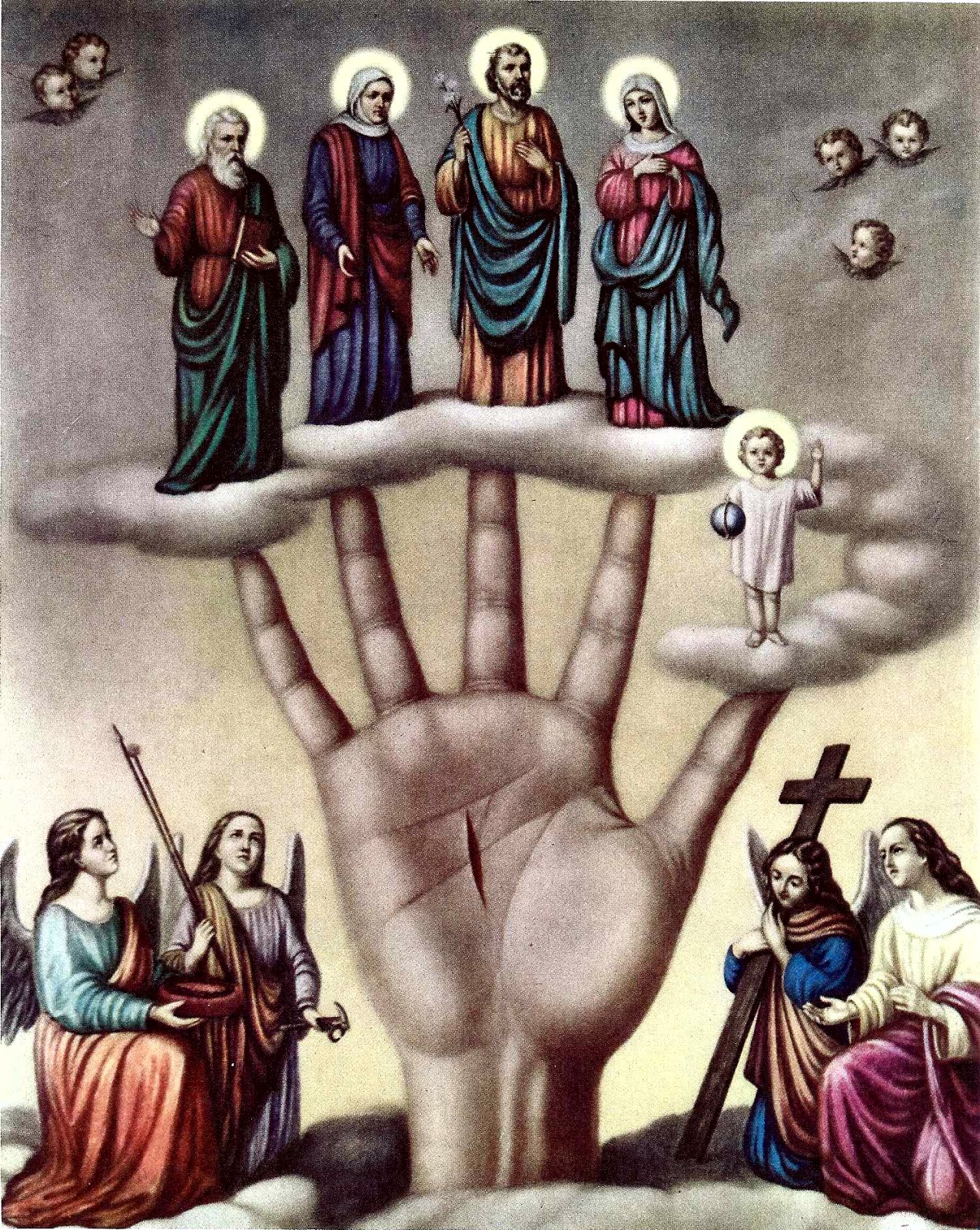
La Mano Poderosa: The Powerful Hand
Recently during a Misa, La Mano Poderosa made an appearance. I nodded, being aware of the image. It wasn’t until after the Misa that I saw this image appear in a dream, which was confirmation to me that this spiritual entity was indeed present during the Misa. Not only that, but I was shown that each finger on the hand represented something different, as well as the segments between the joints. I woke up from this realization and was reminded that what I was shown was like palmistry. Within Palmistry, the segments on each finger represent one’s different personality traits. The longest segments, being their strongest attributes. Perhaps it is our hands that connect us to Divinity. If you think about it, we cannot do much without our hands. We communicate, work, create art and pray with our hands.
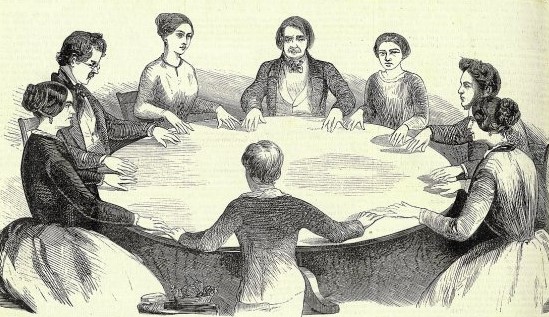
L’Illustration journal universel. 7 et 14 mai 1853
La Mano Poderosa: History and Symbolism
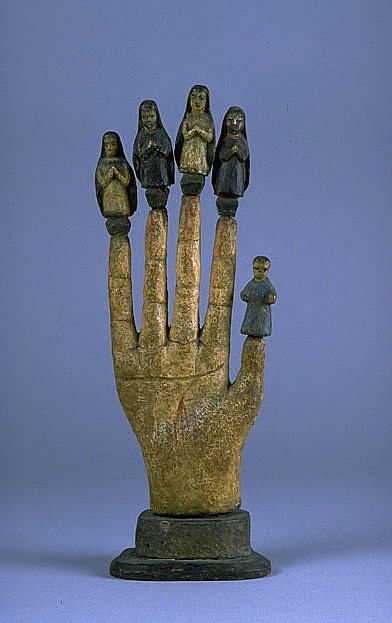
There are many variations on the image of the All-Powerful Hand. What remains the same is that the hand carries the mark of the stigmata and that the Holy family is present, including infant Jesus, Virgin Mary, Saint Joseph, Saint Ann and Saint Joachim.
One of the things that struck me as odd, which could be why I never paid much attention to La Mano Poderosa, is that even though there are saintly figures within the image, there is not one saint that this image represents. The reason why people purchase saint images was to have representation on their altars. For me personally, I like to look directly at the saint so that I feel like I am having a conversation with them. So, who exactly is it that we would be praying to? A hand? What is it about it that makes it so powerful?
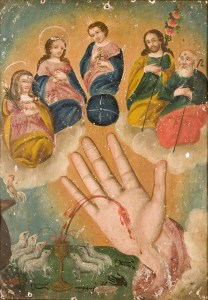
The image of the wound on the hand would point to Jesus. However, another source begs to differ. In a piece of 19th century art that is featured at the New Mexico State University Art Museum, is a retablo, devotional art painted onto a tin sheet in the style of Spanish Folk Art. This style of folk art became popular in Central and Northern Mexico, as well as within the American Southwest between the years of 1820 and 1920.
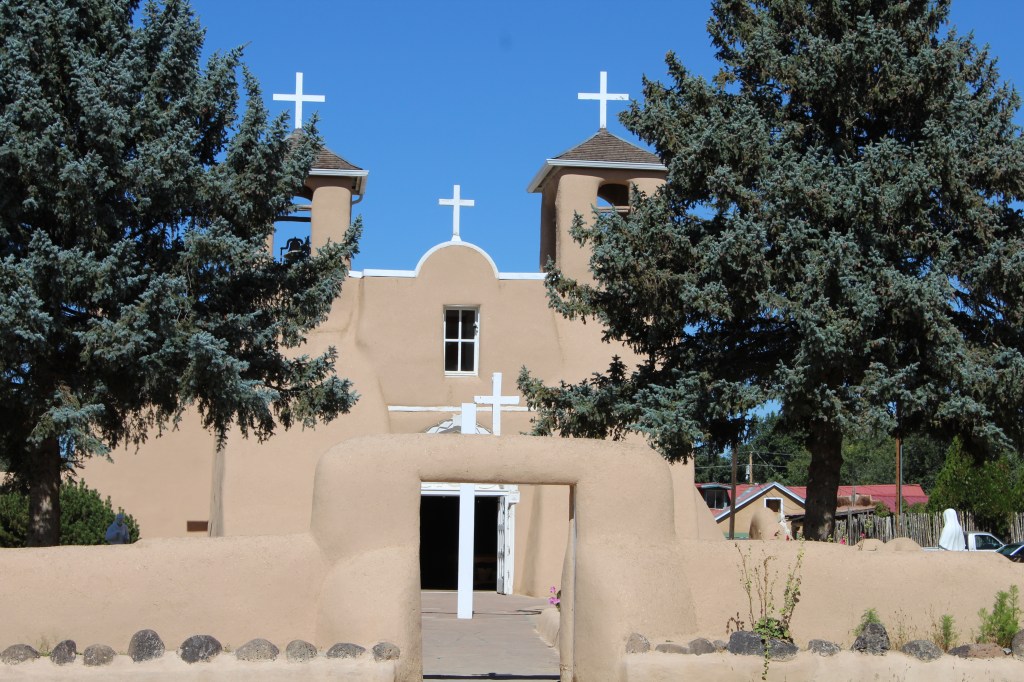
Dr. Emmanuel Ortega and Dr. Lauren Kilroy-Ewbank hypothesize that the hand in the retablo belongs to Saint Francis of Assisi. They came to this conclusion because the sleeve of the robe around the hand is brown. Also, Saint Francis was one of the saints that carried the stigmata of Jesus. Ironically, Saint Francis is a very popular saint in New Mexico. In fact, one of the most unique churches in New Mexico is devoted to the saint, San Francisco de Asis Mission Church. Construction of the Adobe-style architecture started in 1772 and wasn’t finished until 1815. The unique structure became a muse for artists like Georgia O’Keefe and Ansel Adams.
Out of all the saint images in La Mano Poderosa, the infant Jesus is usually depicted over the thumb, which is believed to be attributed the power that thumb holds, even if it is not the largest finger on the hand. The other fingers on the hand are guarded by St. Joseph, Virgin Mary and her parents, Saint Ann and Saint Joachim.
La Mano Ponderosa is seen as a mediating hand between the human world and God’s divine counsel.
But where did La Mano de Ponderosa come from?
Unfortunately, there is not a lot of information on this subject, and we may never actually know its exact origin. Besides the retablo that was previously mentioned, another representation of the La Mano Ponderosa was found in Puerto Rico, dating from the late 1800s. There has been an indication that there may have been a cult of La Mano de Ponderosa during the 19th century. Two novenas dedicated to Mano Ponderosa have been located within Mexico: one from 1807 and another from the year 1819. Even though the evidence of this cult was within the 19th century, there is a good indication that it could possibly be much older. Perhaps La Mano is something that was already woven into Mexican culture and society and evolved, especially after Catholicism took hold over Mexico.
The Spiritual Representation of La Mano de Ponderosa
The first and foremost purpose of La Mano Poderosa is protection, especially when one is the target of their enemies, whether magic is a factor or not. Not only does the hand represent God’s protection, but also protection of the holy family, as well as angelic protection. However, the image of the All-Powerful Hand is not only used for protection. It can act as a “catch all” image for many different purposes, including love, finances, work, health and lost causes. I believe these many attributes are due to the different saints that sit on top of each finger, as they represent their own individual guidance and mysteries. Not only that, but there is a plethora of symbolism within the “saint image” of the holy hand. The blood being poured into a chalice, the seven lambs, the tools that are at the feet of the lambs. Some representations of La Mano Poderosa even have angels present. There is so much that this image, or “saint” can assist with. The fact that this holy image had a cult in the 19th century is telling. What was it that people believed it could do back then and how much of that information is lost now? Even if we never truly know the extent of its mysteries from La Mano’s hidden past, it shouldn’t stop us from exploring its great mysteries.
 Spiritual Folktails
Leave a comment