
Headless Horsemen
When one ponders of the tale of the Headless Horseman, we automatically think of the crisp air of Fall, along with a dark, brooding creature in the dead of night. We think of Irving Washington and his meanderings of The Legend of Sleepy Hollow. But this legend has a long history before Irving ever wrote the story in 1820. The original folklore surrounding this figure started in Europe during the Middle Ages (between 500 and 1500 AD). These headless figures were depicted as riders that were either carrying their heads or missing their heads altogether. And possibly, they were on the hunt in search of their missing heads, striking down and killing those that dare cross their paths.
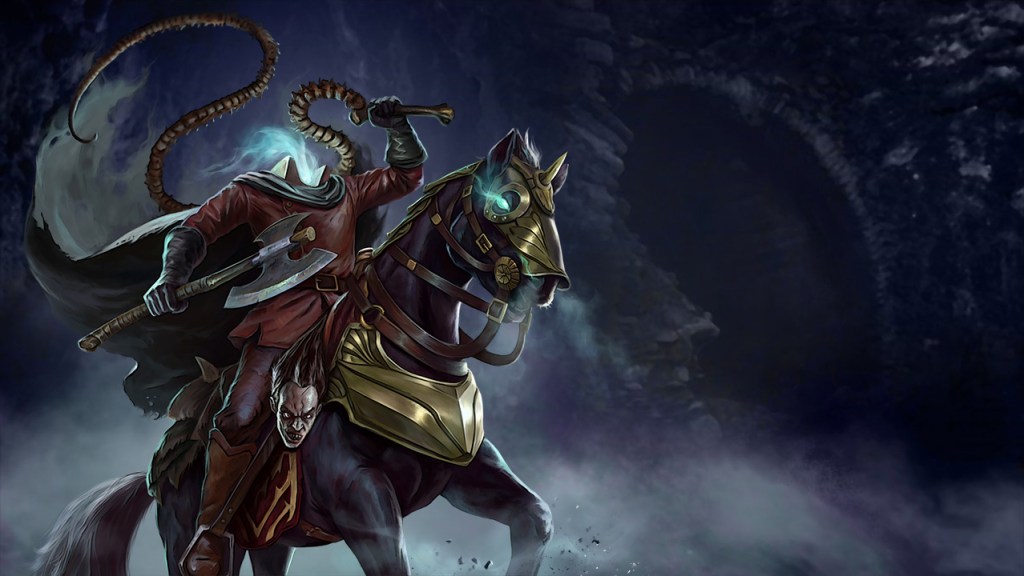
Dullahan
One of the more popular folktales predating Irving’s The Legend of Sleepy Hollow is the Irish Dullahan, which was described as a headless rider on a black horse, or as a coachman that carried his own head. This popular folk story is believed to gain its popularity through Ireland’s oral tradition.
The name Dullahan, or Dulachan in Irish gaelic, refers to a hobgoblin, a generic term for an unseelie fairy and being of a wicked, malicious or dark nature. This being was also referred to as Colainn Gan Cheann, which translates to “without a head” in Irish.
The Dullahan appears as a mounted horseman or as a coachman driving a horse-drawn carriage and is commonly seen in or around graveyards, or vaulted chambers. This unseelie is typically associated with the burial of a corrupt nobleman. The Dullahan arrives at the doorstep of those who are close to death, foreshadowing imminent death and misfortune.
However, there is one exception. The Dullahan can be paid off with gold, enticing the ghostly beast to turn away and retreat into the darkness, looking for another target.

Nuckelavee
Although not a headless horseman, there is a similarly threatening creature on the Orkney Islands of Scotland referred to as Nuckelavee. The Nuckelavee lives within the sea and is a creature that is neither horse nor man, but something combined. It is said to represent a man riding a horse, but the man has no legs. The horse and the man are all one creature. The Nuckelavee isn’t like a Centaur either, where the bottom half of the body is horse-like and top half human. What’s even more disturbing is that this creature has no skin. It is made up of bone and muscle.
The Nuckelavee’s breath was foul enough to make livestock sick with disease and was believed to be responsible for epidemics and drought. There were recorded sightings of this creature as early as the 16th century, many claiming that they survived a confrontation with the beast. However, the descriptions of the creature remained inconsistent between sightings.
The sight of this creature is so terrifying that British folklorist Katharine Briggs referred to it as “the nastiest” of all of beings on Scotland’s Northern Isles. Since a lot of the mythology that comes from Orkney Islands is strongly influenced by the neighboring Scandinavian countries, some folklorists, particularly Ernest Marwick, hypothesize that the Nuckelavee may be a variation of the Norwegian Nøkk, a Nuggle from the Shetland Islands and the Sea Kelpie of Celtic lore.
The only other being said to control the Nuckelavee was the Mither o’ the Sea, an ancient spirit within the mythology of the Orkney islands, said to confine the creature during the summer months. However, it is believed that the Nuckelavee cannot withstand fresh water. One witness named Tammas managed to splash the creature with fresh water, causing it to run away.
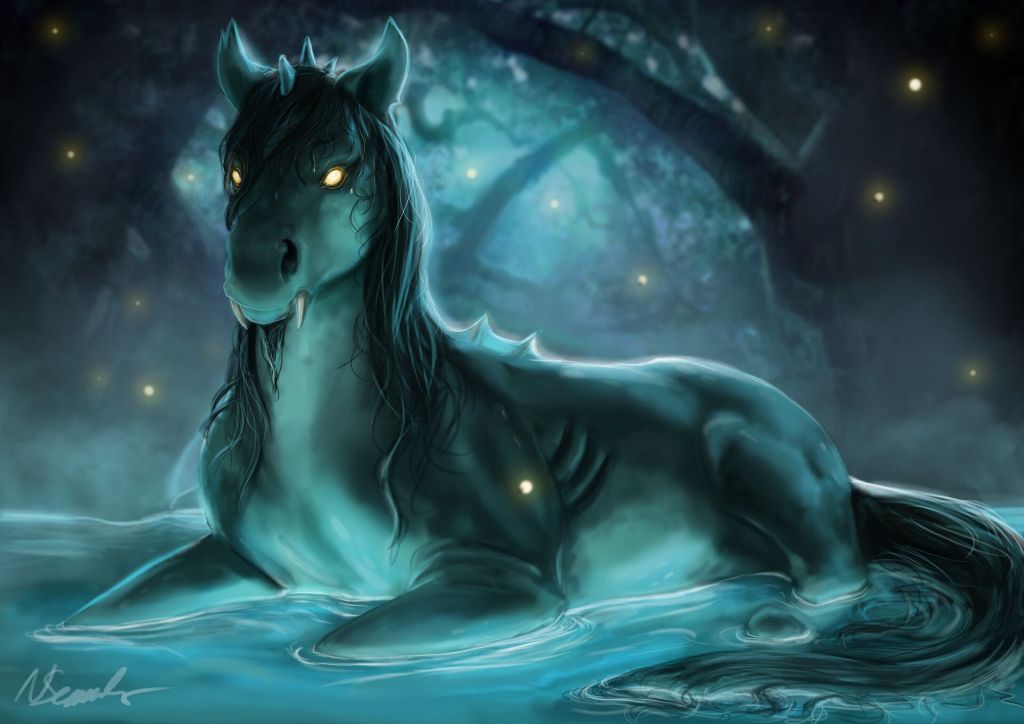
The Kelpie
One of the most popular creatures associated with horses is the Kelpie, who is known for inhabiting lakes, or lochs, in Irish and Scottish folklore. It is considered a shape-shifting spirit that can be described as a black, grey or white horse-like creature, with the ability to change into a human form. In some accounts, the creature still has hooves while in human form, indicating its façade.
Almost every lake within Scotland has a Kelpie legend associated with it, but the body of water with the most reported accounts is Loch Ness, located in the Scottish Highlands. There are other creatures around the world that are similar to the Celtic Kelpie, including the Germanic Nixie, the Australian Bunyip and the Wihwin of Central America.
Commentators and Folklorists commonly disagree about the Kelpie’s acquatic nature. The Kelpie is actually similar to another horse spirit, called Each Uisge. The Each Uisge is described as being more vicious than the Kelpie and has been spotted within bodies of water of Ireland, Scotland and the Isle of Man. In the 19th and 20th centuries, folklorists such as Tiree John Gregorson Campbell, Lewis Spence and Katharine Briggs argued that the Kelpie did not live within the body of water, but near it. However, Sir Walter Scott claimed that the Kelpie’s range may extend to lakes. Over time, that evolved into the kelpie residing in any body of water and it has been hypothesized that there has been some overlapping, or perhaps misinterpretation, between the Kelpie and the Each Uisage creatures.
The kelpie is known to prey on any human beings that it may encounter. One of the creature’s most identifying characteristics is that its hooves are backwards compared to the common horse. The Nykur of Iceland has a similar characteristic, implying that the legend may have some Nordic influence. One variation of the Kelpie comes from Aberdeenshire, located on the eastern coast of Scotland, which portrays the creature with a mane of serpents.
The Kelpie has a deep connection to the element of silver. In one folktale from Barra, an island located in the Outer Hebrides, tells of a lonely kelpie that transforms itself into a handsome man to pursue a beautiful young woman. However, the girl recognizes that the man is an otherworldly creature and removes his silver bridle while he sleeps, reverting him back into a horse-like creature. According to another account that was published by Lewis Spence, a Scottish Folklorist and Occultist, a Kelpie can be killed by a silver bullet, reducing the beast’s body to a shrunken, gelatinous mass, similar to a jelly fish.
There is some speculation that the legend of the Kelpie may have its roots in horse sacrifices that were performed in ancient Scandinavia. However, the earliest account of a Horse-like spirit may have been engraved onto Pictish stones, which are mainly located in Northeastern Scotland and date between the 6th and 9th centuries. There is an engraving entitled the “Pictish Beast,” which can be interpreted as a horse, or a kelpie.
And I looked, and behold a pale horse: and his name that sat on him was Death, and Hell followed with him. And power was given to them over the fourth part of the earth, to kill with sword, and with hunger, and with death, and with the beasts of the earth.
 Spiritual Folktails
Leave a comment